

 English (EUR)
 Česky (CZK)
 Deutsch (EUR)
 Polski (EUR)
 Français (EUR)
 Español (EUR)
 Italiano (EUR)
 Română (EUR)
 Ελληνικά (EUR)
 Dutch (EUR)
 Eesti keel (EUR)
 Português (EUR)
 Magyar (EUR)
 Svenska (EUR)
 Dansk (EUR)
 Suomen kieli (EUR)
 български език (EUR)
 Slovenščina (EUR)
 Slovensky (EUR)
 lietuvių kalba (EUR)
 latviešu valoda (EUR)
Tips for beginners: how to choose CBD, effects, methods of use
- What is CBD?
- How can CBD be used?
- Full spectrum, broad spectrum, or isolate?
- How to choose a suitable CBD variant?
- Overview: bioavailability, onset and duration of effects
- FAQ
- Does CBD have side effects?
- Are CBD products safe?
- Can CBD interact with drugs?
- Is CBD addictive?
- How long does CBD stay in the body?
- Is CBD legal?
- Will CBD show up in a drug test?
- Can CBD be used during pregnancy and breastfeeding?
- What concentration of oil should I choose if I have no experience with CBD?
- Final advice: what to watch out for?
What is CBD?
We have already introduced CBD (cannabidiol) in detail in our previous article, so let's just summarize the basic in formations. Cannabidiol is a non-psychoactive cannabinoid, a natural compound found in the cannabis plant. Scientific studies show that it has a number of potential therapeutic effects based on its interaction with the endocannabinoid system and its action on various receptors in the body - CB1, CB2, on serotonin and vanilloid TRPV1 receptors.
Research suggests that CBD can have a positive effect on sleep quality, relieve stress and anxiety, has the potential to reduce inflammation and pain, and may help with skin or neurodegenerative diseases.
A wide range of CBD products are available on the market: CBD oils and drops, capsules, creams, gummies, edibles, teas, CBD patches, vapes, CBD flowers and more.
How can CBD be used?
CBD can be used in a variety of ways, the most common being:
- Sublingual administration (by dropper under the tongue): CBD oils and drops
- Oral administration: capsules, tablets, gummies, edibles (e.g. biscuits, chocolate, etc.)
- Vaporisation (inhalation of vapour containing CBD): CBD vapes
- Topical administration (application to a specific place on the body): CBD ointments and creams, balms, gels
- Transdermal administration (CBD is released into the bloodstream through the skin): CBD patches
Full spectrum, broad spectrum, or isolate?
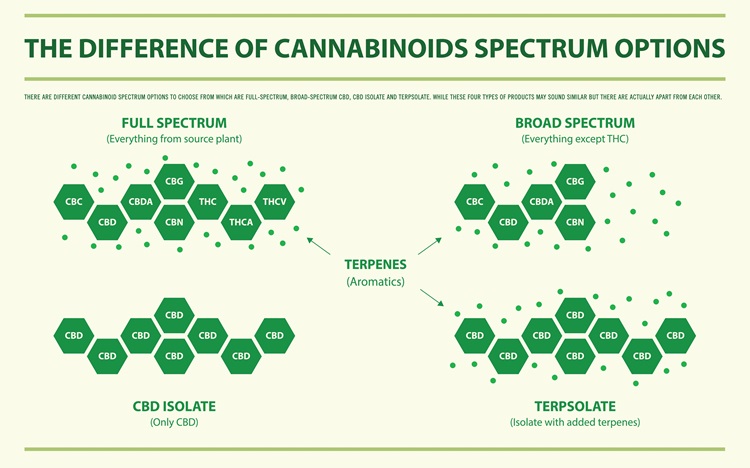
In our last article on CBD, we explained the difference between full-spectrum, broad-spectrum products and CBD isolate.
All of these are suitable for beginners, depending on what you want from the product and whether you want the purest form of CBD or the full spectrum of cannabinoids. Full-spectrum products contain the most of the components that occur naturally in the cannabis plant, i.e. cannabinoids, terpenes and flavonoids. In terms of THC (tetrahydrocannabinol) content, freely available full-spectrum products contain only trace amounts of this psychoactive cannabinoid (usually up to 0,2-0,3 %).
However, if for some reason you prefer a product completely free of THC but containing other cannabinoids and terpenes that can work in synergy to enhance or complement each other (entourage effect), try broad-spectrum CBD oils or capsules.
If you want to start with pure CBD and prefer products without taste and smell, CBD isolate will be suitable for you. In this case, however, you will be missing out on the potential for synergistic effects.
How to choose a suitable CBD variant?
How to find out which form is right for you? Consider the following factors:
- Bioavailability: a term used to describe the amount of the active substance, in this case CBD, that enters the bloodstream. It is expressed as a percentage.
- For example, CBD capsules (oral) have a bioavailability of only 6-20% because they have to pass through the digestive tract and the liver, which means that some of the CBD is metabolised and broken down before it reaches the bloodstream.
- Conversely, when vaping, the bioavailability can be as high as 55-56%. If you need quick relief from acute symptoms (e.g. anxiety), choose forms with high bioavailability and rapid onset of effects, such as CBD vapes or CBD oils and drops.
- How long it takes CBD to take effect and how long the effects last:
- CBD oils and drops usually take effect within 15-30 minutes and the effects can last 4-6 hours.
- When vaping, the onset is almost immediate (within minutes), but the effects last on average 1-3 hours.
- Purpose: Do you want CBD for eczema or sleep problems? While in the first case an external product such as CBD ointment will be suitable, in the second case CBD oils and drops, capsules or CBD vapes will be more suitable.
- Dosage and flavour: If you want to be able to adjust your dosage precisely, try CBD oils and drops or CBD vapes. Of course, even with CBD capsules or CBD gummies you can choose different doses (amounts) of CBD per capsule, but it is always a standardized amount (i.e. x mg of CBD per capsule/gummy).
Some people may be bothered by the "hemp taste" of CBD oil, for these cases there are flavoured CBD vapes, gummies or patches to apply to the skin.
Overview: bioavailability, onset and duration of effects
Now that you know what to look for, choosing the right product will be easier. In the table below, you'll find an overview of each product, information on what bioavailability you can expect, how quickly the product takes effect after use, and how long the effects last.
|
CBD products |
Bioavailability (%) |
Speed of onset of effects |
Duration of effects |
|
Up to 56 % |
Within 5 minutes |
1-3 hours |
|
|
CBD oils and drops (application under the tongue) |
13-35 % |
15-30 minutes |
4-6 hours |
|
Capsules, gummies, edibles |
6-20 % |
1-2 hours |
4-6 hours or more |
|
Gels, ointments, balms, serums |
Probably low, estimated at around 3-5% |
It is impossible to determine exactly, they can arrive in as little as 15 minutes or as long as 3 hours |
Topical effects that may last for several hours |
|
Lack of data, should be higher than for topical preparations and oral administration |
In a matter of hours |
Long-term (24-72 hours) |
Keep in mind that reactions to CBD and effects may vary from person to person, and that the figures in the table are an average guideline. Many factors influence how CBD affects you, such as the concentration and quality of the product, your age, weight, metabolism, your health, etc.
FAQ
If you don't have any experience with CBD yet, chances are you still have a lot of questions and doubts about side effects, safety, use in pregnancy or possible interactions of cannabidiol with other substances. Now, let's take a look at these questions we often get from customers together.
Does CBD have side effects?
Side effects are rare, but if you take too high a dose of CBD, or if you are one of the more sensitive individuals, suffer from a medical condition and/or are taking medication, these side effects may occur:
- Fatigue
- dry mouth
- changes in appetite
- diarrhea
- low blood pressure
These effects tend to be short-lived and should soon wear off, but this does not mean that you should underestimate them. Try reducing the dose or cutting out CBD.
Are CBD products safe?
CBD products are considered safe and are well tolerated by most people. However, it is important to buy from reliable manufacturers/vendors who have CBD products tested by an independent laboratory.
Can CBD interact with drugs?
Yes, CBD can interact with some medications. It can block the effects of drugs or enhance them in an undesirable way, but it can also affect their absorption or amplify side effects. Problems can occur, for example, when CBD is combined with blood thinners, antiepileptics, antidepressants, antipsychotics or cholesterol-lowering drugs (statins). If you have health problems or are taking medication, consult a doctor about CBD use.
Is CBD addictive?
CBD is non-addictive and research suggests that it is not physically addictive.
How long does CBD stay in the body?
CBD can remain in the body for several hours or even several days, depending on the dose, frequency of use, route of administration, and metabolism of the user.
Is CBD legal?
In most countries, CBD products are legal as long as they do not contain more than 0.2 or 0.3% THC (in the Czech Republic, the limit is 1% THC). However, the status of CBD can vary from country to country or region to region, depending on the legislation in the area.
Will CBD show up in a drug test?
Drug tests detect THC (tetrahydrocannabinol), not CBD. Full-spectrum CBD products do contain THC, but usually only small amounts, up to 0.2-0.3%. This could theoretically show up in a test, but it's not very likely, perhaps only if you've taken a really large dose of CBD oil or if you have a heightened sensitivity to the substance. If you are concerned about testing, choose products without THC, such as broad-spectrum oils and drops or CBD isolate.
Can CBD be used during pregnancy and breastfeeding?
The use of CBD during pregnancy and breastfeeding is not recommended. There is not yet enough research to confirm its safety for women during this period.
What concentration of oil should I choose if I have no experience with CBD?
For beginners, 5% or 10% CBD is recommended, the amount and concentration can be found on the product packaging. Start with a low dose and gradually increase as needed. If you are unsure of your choice, consult a specialist CBD shop.
Final advice: what to watch out for?
Buy from reputable manufacturers/sellers who have their goods tested by an independent laboratory. Why is this important? To ensure that the CBD product you choose contains cannabinoids, terpenes and other substances in the amounts and concentrations declared by the manufacturer. The lab analysis will also tell you if the CBD is contaminated with any undesirable substances such as solvents, molds, pesticides or heavy metals.
Ask the dealer to show you the "Certificate of Analysis" (COA). Some sellers publish this document directly on their e-shop pages for each product.
Choose a low concentration product to start with, take only small amounts and monitor your body's reactions. Although CBD is well tolerated by most people, side effects can rarely occur. If this happens, reduce the dose or cut out the product. If you are taking any medications, check with your doctor to see if CBD is suitable and safe for you.
Although much research suggests that CBD can have a number of beneficial effects on the body, it is not a substitute for medication. Always consult your doctor for any medical conditions.
Author: HotHouse Cucumber
Photo: Shutterstock
"All information provided on this website, as well as the information provided through this website, is for educational purposes only. None of the information contained herein is intended as a substitute for medical diagnosis and such information is not to be considered medical advice or recommended treatment. This website does not promote, endorse or advocate the legal or illegal use of narcotic drugs or psychotropic substances or the commission of any other illegal activity. Please see our Disclaimer for further information."